Shape the Future in Person
SXSW London Report
Our freshest insights from tech land.
TL;DR
(Full article below)
SXSW London painted a clear picture of a future that is no longer being imagined—it is being actively built. Across conversations spanning AI, quantum computing, creativity, commerce and immersive technologies, one theme emerged repeatedly: the pace of technological change is accelerating faster than most organizations are prepared for.
While many businesses remain focused on AI productivity tools, researchers and technology leaders are already discussing autonomous agents, specialized intelligence and entirely new operating models. The challenge is no longer whether AI will transform industries, but whether institutions can adapt quickly enough. As several speakers noted, successful adoption requires rethinking processes, leadership and decision-making—not simply deploying new tools.
Europe's role in this future was another major topic. Despite strong research capabilities and startup ecosystems, concerns remain about the region's ability to scale innovation. Speakers argued that Europe should focus on specialized AI models, semiconductor independence and infrastructure ownership rather than competing directly with larger American and Chinese technology players.
The festival also highlighted a growing debate around creativity. While emerging creators see AI as a tool that expands creative possibilities, industry veterans warned that an abundance of content does not automatically produce excellence. The real challenge lies in preserving judgement, craft and effectiveness as technology reshapes creative industries.
Commerce is also entering a new era. As AI agents increasingly act on behalf of consumers, trust, consistency and structured brand experiences will become critical competitive advantages. Similar themes of ownership and transparency surfaced in discussions around open-source technologies.
Looking further ahead, many speakers pointed to spatial computing, world models, XR and AI-powered wearables as the next frontier. The future may move beyond screens toward experiences that understand and interact with the physical world.
Ultimately, the strongest takeaway was not technological but human: progress belongs to the builders, experimenters and leaders willing to move before certainty arrives. Technology may shape the future, but people remain the force driving it forward.
Read the full article below.
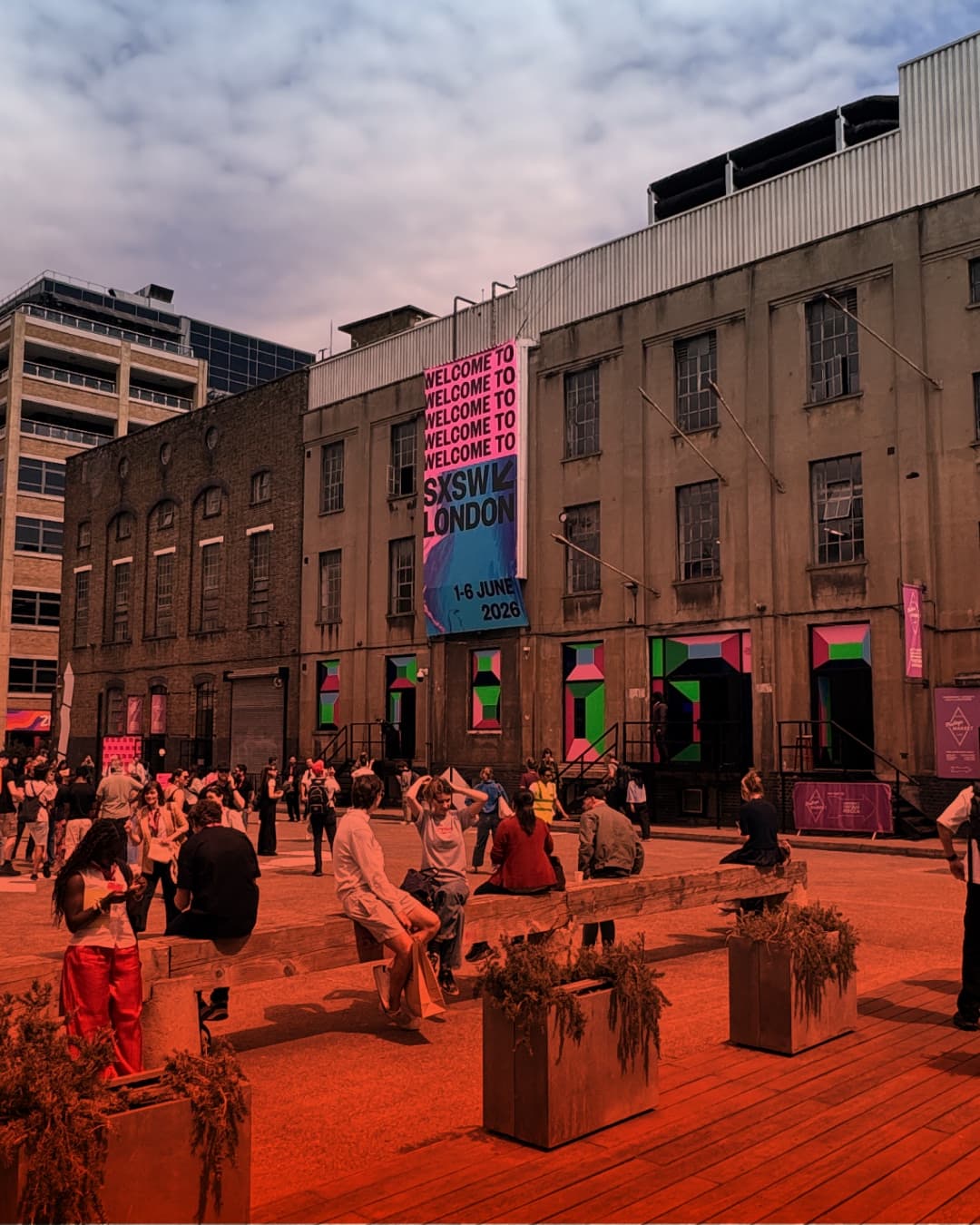
What is SXSW London?
SXSW is Londons version of SXSW Austin. Worlds main tech & culture festival. The original SXSW Austin is like the Olympics of technology, culture and business. But until we’re capable of making that happen, London will do just fine. And perhaps that's fitting.
Because if there was one recurring theme across this year's conversations, it was that the future isn't being predicted anymore. It's being built. Messily. Competitively. In real time.
The people shaping it aren't waiting for certainty. They're experimenting, investing, scaling and occasionally arguing with each other on stage.
Which made one thing abundantly clear: despite headlines suggesting AI is slowing down, the people closest to the frontier see the exact opposite.
Of course, reducing the festival to AI, chips and quantum would be unfair. Across music, film, design and culture, there were dozens of conversations we simply couldn't do justice in a single article. Some explored how artists are navigating an algorithmic world. Others unpacked the future of storytelling, fandom and entertainment. We deliberately left many of those insights where they belonged: in the after-hours conversations. Sometimes the most valuable inspiration arrives somewhere between the final panel, a warm drink and a conversation with a stranger who casually changes your perspective.
The program delivered signals. The evenings delivered serendipity.
AI Isn't Plateauing. It's Accelerating
The gap between public perception and frontier reality is widening.
While many organisations are still figuring out copilots and productivity gains, researchers and builders are already discussing the next generation of agentic systems, autonomous workflows and specialised intelligence.
As David Rosenberg from Oracle put it:
"Technology actually means there's always something more to what we do today."
That sentiment echoed throughout the festival. The question is no longer whether AI will change industries. The question is how quickly institutions can adapt to technologies that improve exponentially while organisations evolve linearly.
Mark Warner, CTO of Accenture and CEO of Faculty, captured the challenge perfectly:
"AI is extremely dynamic so you need to be extremely dynamic as a person."
The winners won't simply adopt new technology. They'll reinvent the processes around it.
As Warner noted:
"Reinventions only grow when the process changes. Like when electricity replaced steam, it took years to realize that many small generators outperformed a large machine."
History rarely repeats itself. It does, however, rhyme remarkably well.
Europe's Next Bet: Intelligence Infrastructure
If AI dominated the conversation, quantum computing sat patiently in the wings as the next frontier.
The strategic concern wasn't technical capability. It was ownership.
Europe finds itself in a familiar position: exceptional research, world-class talent and a tendency to let others commercialize the outcome.
Professor Jason McEwan from the Alan Turing Institute argued that Europe should focus on specialised Small Language Models rather than attempting to outspend American and Chinese giants.
"Europe needs to focus on narrow specialist SLMs. Especially for important topics."
David DeSanto, CEO of Anaconda, extended that argument further:
"With custom experiences we can truly make a difference from the generalist models of the US and China."
In other words: don't fight the battle they're fighting. Create a different one.
But strategy alone won't solve Europe's structural problem.
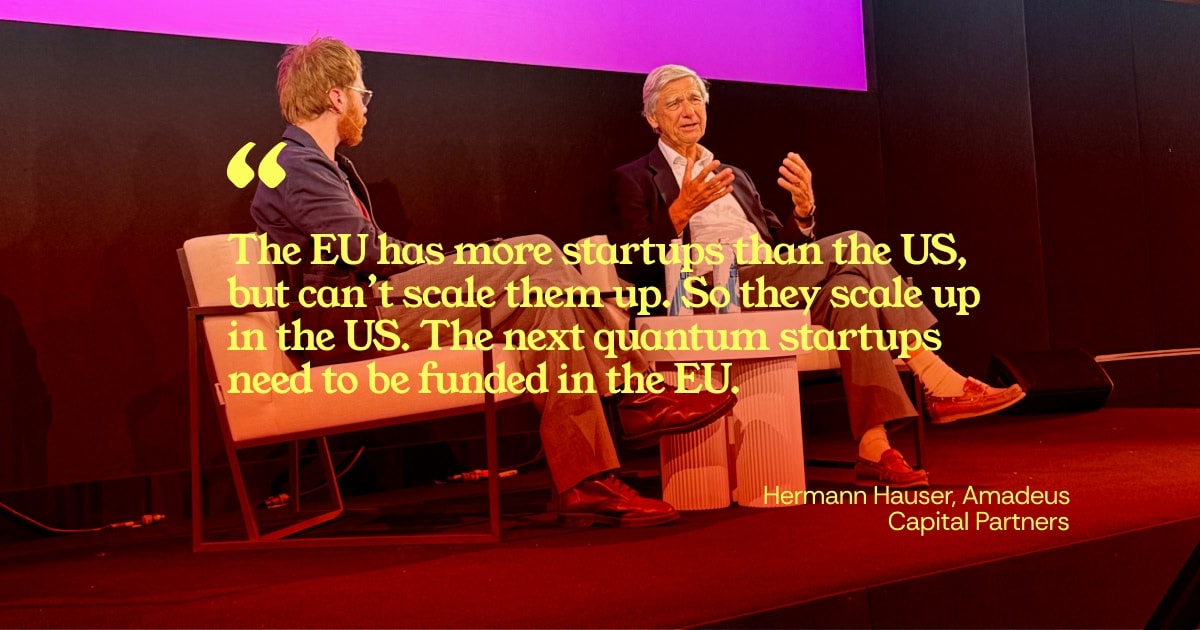
As Hermann Hauser of Amadeus Capital Partners bluntly observed:
"The EU has more startups than the US, but can't scale them up. So they scale up in the US."
That concern surfaced repeatedly throughout discussions around semiconductors, AI infrastructure and quantum computing.
Hauser argued that data centers should be treated as critical infrastructure, comparable to energy and water systems. He also advocated for EU Inc., a proposed pan-European legal framework designed to help founders scale beyond national borders. A European Delaware.
Because if Europe wants to shape the future, it needs more than talent. It needs tailwinds.
Fabrizio Del Maffeo, CEO of Axelera AI, put it even more directly:
"If Europe gives up the semiconductor, we don't manage our future."
The New Creativity Debate
Technology wasn't the only battleground.
Creativity itself is undergoing an identity crisis.
On one side stand a new generation of creators embracing AI, immersive technologies and computational creativity to remix culture at unprecedented speed. For them, technology is not replacing creativity. It's expanding the canvas.
On the other side stand advertising legends such as Sir John Hegarty, David Droga and Rory Sutherland, defending creativity as craft, judgement and commercial effectiveness. Creativity with the big C – the C of Commercial?
Their concern isn't that AI creates content. Their concern is that it creates too much of it. The debate often gets framed as humans versus machines. That might not be the right framing. The real tension they describe is between abundance and excellence. Don’t know whether “Humans in the Loop” is the right framing either.
David Droga perhaps summarised the broader challenge best:
"The agency business model is severely broken."
Not because creativity is disappearing. Because the economics around it are being rewritten. That’s a frame to start from.
The Rise of Agentic Commerce
The shift toward autonomous systems extends well beyond creativity.
Commerce is next.
Klarna's Catherine Comerford described a future where brands increasingly optimize not for human searches, but for AI agents acting on behalf of consumers.
"We're moving from an intent to an agentic commerce protocol."
That future rewards structure, consistency and trust.
"You can't outprice trust. Expertise, authority and trust are key in the agentic space."
Wesley ter Haar, co-founder of Monks, reinforced a similar point from a brand perspective.
"Brand guardrails are crucial to let brands run through all touchpoints."
Because when agents, algorithms and automation become the interface, consistency becomes a competitive advantage.
The Future Gets a Third Dimension
Much of the AI conversation today still happens through a 2D interface: prompts, chat windows and screens.
But several speakers pointed towards something bigger. The next leap isn't simply smarter models. It's AI that understands space, movement and the physical world itself.
As Runway co-founder Anastasis Germanidis put it:
"We're going from a 2D to a 3D understanding of the world and with it to realtime creation of virtual spaces."
That shift surfaced repeatedly across discussions on world models, robotics and spatial computing.
Victor Prisacariu, Chief Scientist at Niantic Spatial, argued that the future of AI training will increasingly move beyond internet data:
"In 5 years we'd see a blend of spatial world understanding and prediction of physical situations. The future of AI training isn't more internet data—it's robots generating data in the real world."
The implication is profound. For years, AI has largely learned from humanity's digital exhaust. The next generation may learn directly from reality itself.
DeepMind's Jack Parker-Holder described world models as a new creative substrate:
"World models unlock use cases we haven't even imagined yet—they're becoming a new layer of human creativity."
And perhaps most strikingly, Germanidis reminded the audience that some of AI's most powerful capabilities aren't explicitly designed at all:
"The most powerful capabilities of AI aren't programmed—they emerge naturally from models learning reality."
The industry often talks about intelligence as prediction. Increasingly, it may be about simulation.
Open, Owned and Built to Last
Another recurring theme was ownership.
Contrary to popular assumptions, open source is increasingly viewed as a strategic advantage rather than a compromise.
As WordPress executive director Mary Hubbard observed:
"Open source models are actually the most owned. As the code is visible and available."
Transparency creates trust. And trust, once again, emerged as one of the defining currencies of the next era.
The new VR and XR era
We’re moving from screens to worlds.
AI is unlocking sectors that were stuck for years because the data, compute and interaction models weren’t ready yet – the scope of disillusionment for VR was quite steep. Now, world models, spatial AI and XR are starting to merge into one new creative layer: experiences you don’t just watch, but step into.
Anastasis Germanidis, co-founder of Runway, said it sharply:
“Within five years, AI-generated VR experiences may become indistinguishable from reality.”
That’s the real shift.
VR and XR are no longer only about immersion. They’re becoming interfaces. New ways to learn, play, navigate, shop and experience brands.
And Meta is moving fast to own that layer.
Their work in smart glasses, audio capture and AI wearables shows where this is heading: less screen, more presence. As Andy Mesecher from Meta put it:
“The best interface is often no interface at all. Audio becomes the UX when screens disappear.”
When screens fade, voice, sound and context become the interface.
That’s why AI wearables and XR won’t break through because they feel futuristic. They’ll break through when they feel natural.
AI Is a Leadership Challenge Disguised as a Technology One
One of the most consistent misconceptions discussed throughout the week was the belief that AI adoption is primarily a training problem.
Greg Freeman, Founder of the Data & AI Literacy Academy, argued the opposite:
"Thoughtful fear is AI's biggest competitor. Most companies approach AI as an L&D initiative. That's backwards. AI adoption is a change management process first and a training process second."
The challenge isn't teaching people which buttons to press. It's helping organizations rethink how decisions get made.
As Freeman noted:
"Too many people operate horizontally—within teams, functions and workflows. AI rewards vertical thinking: understanding how decisions ripple through the entire business."
Or more simply:
"We need less buttonology. More systems thinking."
That idea echoed beyond AI.
Atomico partner Andreas Helbig pointed to ownership as a competitive advantage:
"When you own your dashboard & own end-to-end solution, you can disrupt quicker."
Meanwhile, Firstminute Capital investor Sam Endacott challenged the narrative that AI lowers the barrier to building enduring companies:
"Vibe coding? You need to be more technical than ever before to start a long-term business."
The message was consistent. AI may make creation easier. It doesn't make strategy optional.
Reshma Sohoni, Co-Founder of Seedcamp, perhaps captured the balance best:
"AI is a methodology to be able to build what we need to build."
Not the destination. The methodology.
And while technology dominated the headlines, Tim Berners-Lee offered a reminder of where value ultimately accumulates:
"Build systems that empower the individual. It is the highest layer on the tech stack."
Perhaps that's the real throughline connecting everything discussed throughout the week.
The future isn't being built to replace people.
It's being built by people, for people, and increasingly around a deeper understanding of how people experience both digital and physical worlds.
Beyond the Main Stage
Of course, not every insight came from discussions on AI, quantum computing or European competitiveness. There were countless conversations in music, film, design and culture that deserve their own articles.
Some ideas arrived during keynotes. Others surfaced over coffee, late-night debates and accidental encounters between people who would never normally share a room.
The official programme delivered knowledge. The after-hours delivered perspective. Both mattered.
Shape the Future in Person
The title wasn't accidental.
Because the strongest takeaway wasn't technological. It was human.
Progress has always belonged to people willing to believe something better can be built before there's evidence that it will work.
The builders. The experimenters. The founders. The researchers. The creatives. The people with enough conviction to keep moving while everyone else waits for certainty.
Technology will shape the future. But only because people do.
And that's exactly why it still matters to show up in person.